
Have you been told your writing style needs to be more concise? Or that your writing is “wordy?” But what does this really mean?
Writing Tip: A wordy writing style occurs when ideas and information are buried in too many words.
What makes writing wordy?
There are many reasons why writing ends up wordy. Sometimes we’re just trying to impress someone with our ideas. Think of those academic papers or cover letters for job applictions.
Instead of focusing on clarity, we keep writing and writing and writing.
Our ideas get lost like a life raft floating on the ocean.
But wordy writing can happen other ways, too.
Sometimes wordy writing is a result of not using specific words to make our meanings clear.
So, we write “Ben was jumping over the fence” instead of “Ben jumped the fence.”
Indeed, there are a number of danger signals for wordy writing.
What Does the Writer’s Diet Tool Do?
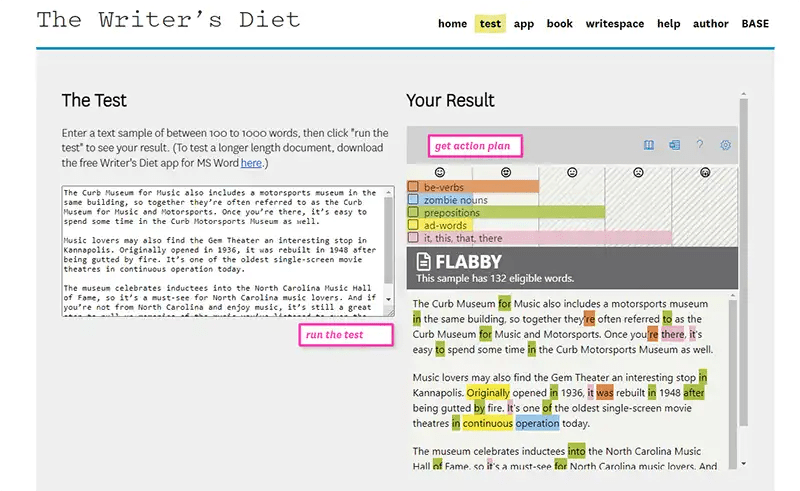
The Writer’s Diet tool applies a simple algorithm to samples of at least 100 words to analyze “wordy or flabby” writing. Developed by Dr. Helen Sword, the tool identifies words falling into five grammatical categories. Typically, overusing these categories take sentences from trim to flabby.
- be-verbs (forms of the infinitive to be such as is, was, am, etc.);
- zombie nouns (abstract nouns created from other words such as investigation where the action is removed from investigate);
- prepositions (words like in, at, from, between, etc.);
- ad-words (words created by adding the prefix, ad);
- it, this, that, there (non-specific words used as dummy subjects)
Here’s a screenshot example showing you the results of a Writer’s Diet test.
How Does Reducing “Flab” Improve Writing?
Reducing flab in your writing makes content easier to understand. When you reduce flab, you use specific verbs, so the action is clear. It’s really important on the Web to write focused content with a specific call to action. Trim writing can help you do that.

And, of course, if you’ve ever been in a writers’ critique group, you’ve probably heard the old adage to “show don’t tell.” Fit and trim writing does just that by using concrete language and images.
Getting rid of wordy flab helps your writing come to life. Try it now and copy 100 words from your latest work into the Writer’s Diet tool.
Need Help Writing Book Descriptions?
Before you go, I thought I’d share another free tool I use regularly to keep my book descriptions fit and trim. It’s from the Kindlepreneur (Dave Chessom), in case you haven’t discovered his resources yet.
Read More Reviews of Writing Tools
- Is Publisher Rocket Worth It?
 Publisher Rocket is an indispensible tool for authors at every career stage. Learn about what’s selling in the Amazon marketplace and how authors’ are doing it!
 - 4 Inside Scoop Tips to Easily Choose Character Names
 Discover four insider tips on how to choose a main character’s name using great free tools, including ChatGPT.
 - How to Plan a Novel Series Made Easy with AI: Setting
 Learn how to plan an outline for a novel series, starting with setting. This article shows how to conduct setting research using ChatGPT artificial intelligence or AI.
 - Best Free Tool for Concise Writing
 Wordy writing buries ideas in your content, but here’s a free tool to get your writing fit and trim!









 Linda Aksomitis
Leave a comment