
It’s hard to imagine that the category a book is in can have a HUGE impact on sales, isn’t it? After all, the book doesn’t change. The book’s description doesn’t change. And the author doesn’t change.
You may have just finished reading my last article, where I’ve been experimenting with the new Publisher Rocket features. In it, I went through some changes I’ve been making to the product listing for The Lion and the Mouse: An Aesop Fable Beginner Reader Mouse Story.
In this article, I’m going to continue making changes to the book listing using Publisher Rocket (note that I’m an affiliate so will receive a commission at no cost to you if you purchase it).
How Do You Find Out Which Categories Have Higher Sales?
There are two ways to find out what categories have higher sales.
- Manually follow these steps from the Kindlepreneur website.
- Use Publisher Rocket Competition Analyzer feature.
So, let’s go back to The Lion and the Mouse. Here’s the results of my search, with the steps below the graphic.

- Step 1 – Open Publisher Rocket
- Step 2 – Select Competition Analyzer from the toolbar
- Step 3 – Enter a term in the New Competitor Analysis pop-up box – I used “lion and mouse” for Kindle Only
- Step 4 – Select “See the Categories” for the first book in the last column or for your own book (the image above is for my ebook)
That was easy, wasn’t it?
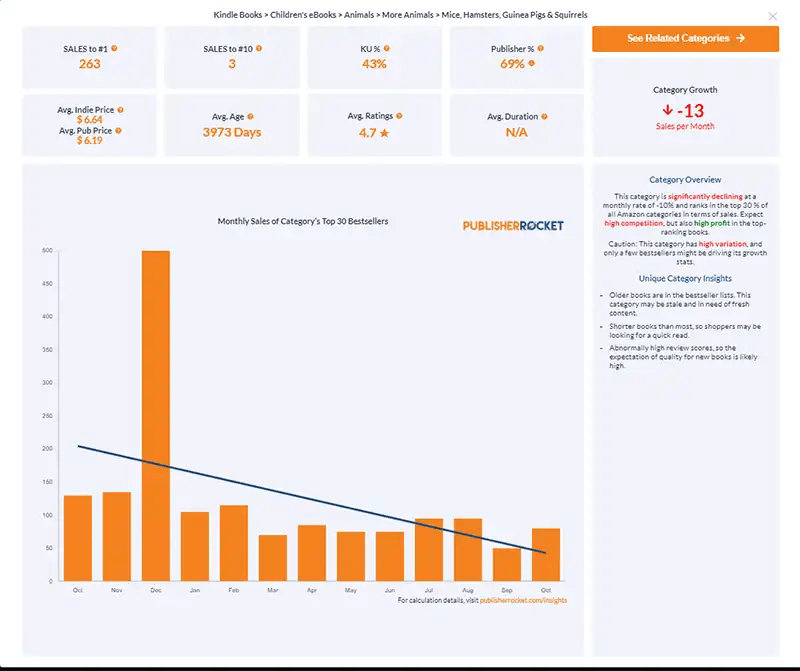
Deciding what categories to aim for with The Lion and the Mouse was easy too! Since the book isn’t out in paperback yet (maybe soon), the first three categories aren’t in my top choices. However, if you compare the “Books > Children’s Books > Animals > Mice, Hamsters, Guinea Pigs & Squirrels to the corresponding Kindle category, you can see that print book SALES to #1 (546 daily sales) are more than double the Kindle sales to #1 (263 daily sales).
Hmm, guess I should get on those paperback and hardcover editions.
Anyway, did you notice that only two categories (European fairy tales, folk tales & myths in print and Kindle) are selectable?
How Do You Get Into a Category Not Listed as Selectable?
When you upload your books to Amazon some categories are listed as selectable. So, you just choose them when you upload the book and you’re likely to end up in them.
However, in my list for The Lion and the Mouse, two of the categories aren’t listed as selectable. The problem for my book is that the category specifically for books about mice sells TONS more books (263) than the one that is selectable (European fairy tales only has 4).
Luckily, Publisher Rocket’s features of Insights and Keywords can help with that!
Here are some insights below — they’ll help you decide on which categories may be the best money makers. Well, that and provide you with some additional information you can use in decision making. For example, this data tells me that the category is dominated by traditional publishers with the majority of sales being long-time sellers (the #10 ranking book only has 3 sales…). Only 43% are in Kindle Unlimited though, so that’s a plus for my title.
And now, for the most important feature here — the keywords that will help get you into categories not listed as selectable.
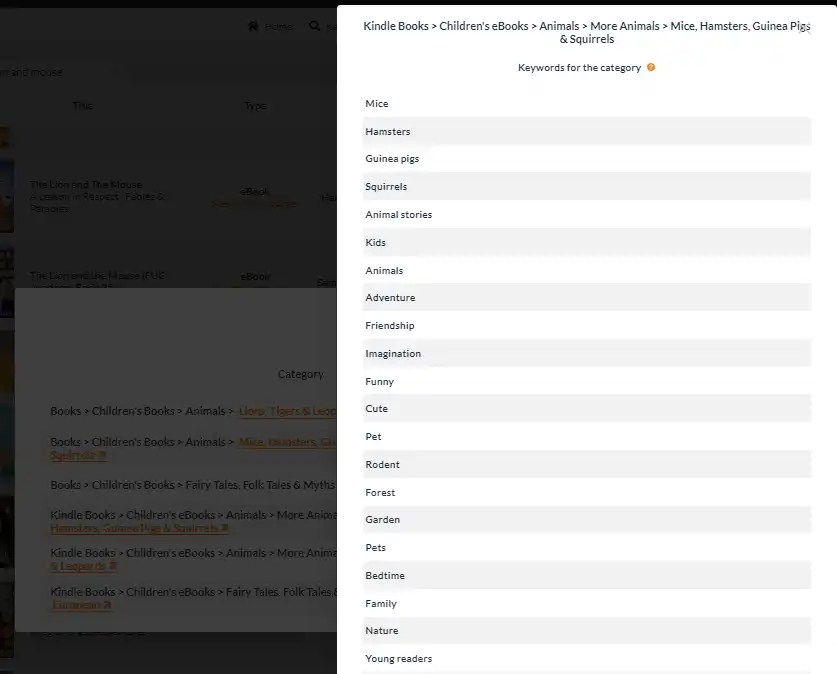
So, the keyword list gives you words to enter in Amazon’s list of 7 keywords. In the case of The Lion and the Mouse, a number of the words aren’t useful. I can rule out all the animal names not a mouse and focus on keywords that describe the story instead. These include: animal stories, adventure, friendship, imagination, forest, and young readers.
Of course, I can also check out the list of keywords for categories for European folk tales and Lions to come up with my final list.
Something to Keep in Mind About Best Seller Lists
It’s always tempting to aim high, isn’t it? We’d all love to be the #1 seller in a category like Books > Children’s eBooks > More Animals > Mice, Hamsters, Guinea Pigs & Squirrels with those 263 ebook daily sales.
However, when you’re just starting out getting found among Amazon’s millions of books may come first.
So, you may be wise to aim high with one category selection and aim for appearing in a best seller (top 100) list with one.
That’s where we simply turn around our perception of the numbers.
Yes, a big number of daily sales means lots of $$$. However, a small number of daily sales means much easier to get on the best seller list.
How’s that work? Well, the category for children’s European fairy tales only needed 4 sales daily to get to #1 — and just 1 sale daily to get to #10. So, if you sell two books in a day, you’ll likely rank around #5 on the best seller list. Woo hoo!
You may also be interested in the K-Lytics report on children’s literature. It sums up a lot of useful information about the market.
Need help writing your Web promotional materials? Join me in my course, Write Effective Web Content. The course is also offered through Gale courses in public libraries in North America. Your public library may even pay the registration fees for you!













 Linda Aksomitis
Leave a comment